- Description
- Curriculum
- FAQ
- Reviews
Residential Lease Agreements Masterclass (South Africa)
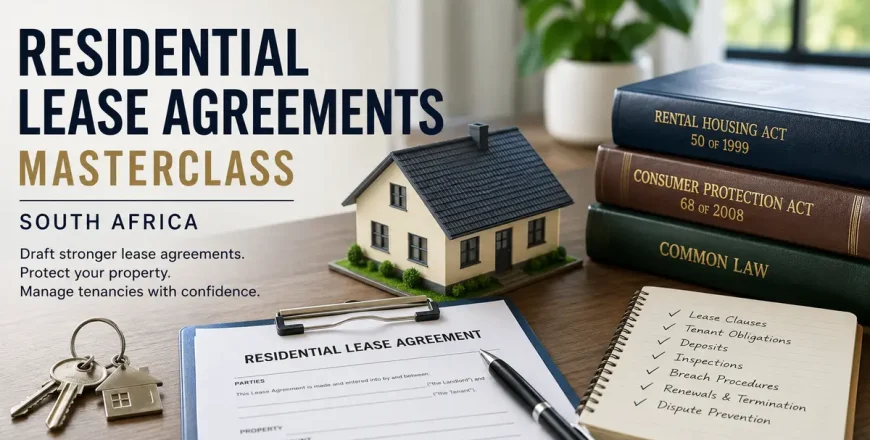
The Residential Lease Agreements Masterclass is a comprehensive training programme designed to help South African landlords, property investors, letting agents, and property managers understand how to create, manage, and enforce residential lease agreements effectively and lawfully.
A well-drafted lease agreement is one of the most important tools available to a landlord. It establishes the rights and responsibilities of both parties, protects rental income, reduces disputes, and provides a clear framework for managing the tenancy. This course provides practical guidance on every stage of the lease lifecycle, from drafting and signing the agreement through to renewals, variations, inspections, dispute resolution, and termination.
Throughout the course, learners will gain a thorough understanding of the South African legal framework governing residential leases, including the Rental Housing Act, Consumer Protection Act (CPA), common law principles, POPIA considerations, and municipal compliance requirements. The course also explores essential lease clauses, deposit management, tenant and landlord obligations, breach procedures, rental arrears, lease enforcement, and best practices for maintaining legally compliant tenancy records.
In addition, the course examines specialised lease provisions for different property types, including flats, sectional title units, free-standing houses, furnished properties, student accommodation, shared housing, and staff accommodation. Learners will also discover how to avoid common lease drafting mistakes, implement professional document management systems, conduct inspections correctly, and manage deposit disputes using proper evidence and record-keeping procedures.
By the end of this course, participants will have the knowledge and confidence to draft stronger lease agreements, protect their properties, minimise legal risks, improve tenant relationships, and manage residential tenancies professionally in accordance with South African law.
Whether you are a first-time landlord or an experienced property professional, this course provides the practical knowledge an
Module 1: Introduction to Residential Lease Agreements
-
1
 Lesson 1: What Is a Residential Lease Agreement?
Lesson 1: What Is a Residential Lease Agreement?
This lesson introduces the purpose and importance of a residential lease agreement in South Africa. You will learn what a lease agreement is, why it forms the foundation of the landlord-tenant relationship, and how a properly drafted lease helps protect the rights, responsibilities, and interests of both parties. The lesson also explains the legal significance of written agreements and the risks associated with poorly prepared or incomplete leases.
-
2
Lesson 2: The South African Legal Framework
Lesson 2: The South African Legal Framework
This lesson provides an overview of the key laws and regulations that govern residential lease agreements in South Africa. You will learn how the Rental Housing Act, Consumer Protection Act (CPA), common law, POPIA, and municipal by-laws affect landlords and tenants, and why understanding these legal requirements is essential for creating compliant lease agreements and managing rental properties professionally.
-
3
Lesson 3: Fixed-Term vs Periodic Leases
Lesson 3: Fixed-Term vs Periodic Leases
This lesson explains the key differences between fixed-term and periodic (month-to-month) lease agreements. You will learn how each type of tenancy operates, the rules surrounding renewals and extensions, the rights of landlords and tenants when ending a lease, and how to choose the most appropriate lease structure for different rental situations.
Module 2: Essential Lease Clauses
-
4
Lesson 1: Parties, Property and Occupation Details
Lesson 1: Parties, Property and Occupation Details
This lesson examines one of the most important sections of any residential lease agreement: accurately identifying the parties, the rental property, and who is permitted to occupy it. You will learn how to correctly record landlord and tenant information, describe the premises, define authorised occupants, and specify the permitted use of the property to reduce disputes and ensure legal clarity throughout the tenancy.
-
5
Lesson 2: Rent, Payment Terms and Increases
Lesson 2: Rent, Payment Terms and Increases
This lesson explains the essential elements of a rent clause and how to clearly set out payment obligations in a residential lease agreement. You will learn how to specify rent amounts, payment dates, banking details, proof of payment requirements, procedures for annual rent increases, and the consequences of late or missed payments, helping to ensure smooth rent collection and minimise disputes between landlords and tenants.
-
6
Lesson 3: Deposits and Holding Deposits
Lesson 3: Deposits and Holding Deposits
This lesson explains how to properly manage tenant deposits and holding deposits in accordance with South African law. You will learn how to draft effective deposit clauses, calculate and account for interest, manage deposits in trust accounts, conduct required inspections, make lawful deductions, process refunds, and minimise disputes at the end of the tenancy.
Proper deposit management is essential for protecting both landlords and tenants and ensuring compliance with the Rental Housing Act.
Module 3: Tenant Obligations
-
7
Lesson 1: Use and Care of the Property
Lesson 1: Use and Care of the Property
This lesson explains the tenant's responsibilities for the day-to-day use and care of a rental property. You will learn how lease agreements should address cleanliness, maintenance, reporting defects, preventing damage, and the lawful use of the premises.
Clear obligations help protect the property, reduce disputes, and ensure that both landlord and tenant understand their responsibilities throughout the tenancy.
-
8
Lesson 2: Utilities, Services and Municipal Charges
Lesson 2: Utilities, Services and Municipal Charges
This lesson explains how lease agreements should address utility services and municipal charges associated with a rental property. You will learn how to allocate responsibility for electricity, water, refuse removal, sewerage, prepaid meters, municipal accounts, and other consumption-based charges.
Clear utility clauses help prevent misunderstandings, ensure accurate billing, and reduce disputes between landlords and tenants throughout the tenancy.
-
9
Lesson 3: Conduct, Nuisance and House Rules
Lesson 3: Conduct, Nuisance and House Rules
This lesson explains the behavioural obligations tenants must comply with during their tenancy. You will learn how lease agreements should address issues such as noise, overcrowding, pets, smoking, visitors, illegal activities, and compliance with body corporate or estate rules.
Clear conduct and house rule provisions help maintain a peaceful living environment, protect the property, and reduce disputes between landlords, tenants, and neighbouring residents.
Module 4: Landlord Obligations
-
10
Lesson 1: Maintenance and Repairs
Lesson 1: Maintenance and Repairs
This lesson explains a landlord’s responsibilities for maintaining a rental property and addressing repair issues during a tenancy. You will learn about landlord repair obligations, the handling of structural defects, emergency repairs, and the distinction between fair wear and tear and tenant-caused damage. Understanding these responsibilities helps ensure legal compliance, protect the property’s value, and reduce disputes between landlords and tenants.
-
11
Lesson 2: Access, Inspections and Privacy
Lesson 2: Access, Inspections and Privacy
This lesson explains the balance between a landlord’s right to access a rental property and a tenant’s right to privacy and peaceful occupation. You will learn when landlords may lawfully enter the premises, how much notice should be provided, the purpose of routine inspections, circumstances permitting emergency access, and the importance of maintaining accurate inspection records.
Clear access procedures help protect the property while respecting tenant rights and reducing potential disputes.
-
12
Lesson 3: Safety, Habitability and Compliance
Lesson 3: Safety, Habitability and Compliance
This lesson examines a landlord’s duty to provide and maintain a safe, habitable, and legally compliant rental property. You will learn about health and safety responsibilities, managing electrical and plumbing risks, complying with municipal requirements, addressing hazards that may affect occupants, and implementing practical risk-reduction measures.
Understanding these obligations helps protect tenants, preserve property value, and reduce the likelihood of disputes, liability, and regulatory action.
Module 5: Breach, Arrears and Enforcement
-
13
Lesson 1: What Constitutes Breach of Lease?
Lesson 1: What Constitutes Breach of Lease?
This lesson explains what constitutes a breach of a residential lease agreement and how landlords can identify and address non-compliance by tenants. You will learn about common breaches such as non-payment of rent, property damage, nuisance behaviour, unauthorised occupants, illegal use of the premises, and repeated minor violations.
Understanding breaches is essential for enforcing lease terms, protecting your property, and taking appropriate action when tenants fail to meet their contractual obligations.
-
14
Lesson 2: Breach Notices and Rectification Periods
Lesson 2: Breach Notices and Rectification Periods
This lesson explains how landlords should properly address lease breaches by issuing clear and legally compliant breach notices. You will learn what information a breach notice should contain, how much time should be given to remedy a breach, the impact of the Consumer Protection Act (CPA), acceptable methods of delivery, and the importance of retaining evidence of service.
Proper breach procedures help landlords enforce lease agreements fairly, reduce disputes, and strengthen their position should legal action become necessary.
-
15
Lesson 3: Remedies Available to the Landlord
Lesson 3: Remedies Available to the Landlord
This lesson examines the legal remedies available to landlords when tenants fail to comply with their lease obligations. You will learn about lease cancellation, recovering rental arrears, claiming damages, lodging complaints with the Rental Housing Tribunal, pursuing court action, and enforcing your rights through lawful procedures.
The lesson also highlights the risks of unlawful self-help measures, such as lockouts or utility disconnections, and explains why landlords must follow the correct legal process when resolving disputes.
Module 6: Renewal, Variation and Termination
-
16
Lesson 1: Lease Renewals and Extensions
Lesson 1: Lease Renewals and Extensions
This lesson explains how residential lease agreements can be renewed or extended at the end of a tenancy. You will learn about renewal options, notice requirements, rent review provisions, the risks associated with automatic renewal clauses, and the importance of properly documenting renewal agreements.
Understanding these processes helps landlords maintain continuity of occupation, avoid disputes, and ensure that lease terms remain clear and enforceable.
-
17
Lesson 2: Varying Lease Terms Lawfully
Lesson 2: Varying Lease Terms Lawfully
This lesson explains how landlords and tenants can legally amend the terms of a residential lease agreement during the tenancy. You will learn how to make changes to rent, authorised occupants, property rules, payment arrangements, and other lease conditions through properly drafted written agreements.
Understanding the correct variation process helps ensure that amendments are legally enforceable, clearly documented, and accepted by both parties, reducing the risk of future disputes.
-
18
Lesson 3: Terminating the Lease Agreement
Lesson 3: Terminating the Lease Agreement
This lesson explains the various ways in which a residential lease agreement can come to an end. You will learn about lease expiry, cancellation for breach, tenant and landlord notice requirements, Consumer Protection Act (CPA) considerations, early termination rights, and the procedures for returning possession of the property.
Understanding the correct termination process helps landlords avoid disputes, ensure legal compliance, and achieve a smooth handover at the end of the tenancy.
Module 7: Inspections, Evidence and Deposit Disputes
-
19
Lesson 1: Entry and Exit Inspections
Lesson 1: Entry and Exit Inspections
This lesson explains the importance of conducting thorough entry and exit inspections at the beginning and end of a tenancy. You will learn how joint inspections help establish the property's condition, protect deposit claims, and reduce disputes.
The lesson covers check-in and check-out reports, photographic evidence, key handovers, utility account management, meter readings, and best practices for documenting the condition of the property throughout the tenancy.
-
20
Lesson 2: Evidence for Damage and Deductions
Lesson 2: Evidence for Damage and Deductions
This lesson explains the importance of gathering and preserving evidence when assessing property damage and making deductions from a tenant’s deposit. You will learn how photographs, inventories, invoices, quotations, correspondence, contractor reports, inspection records, and other supporting documents can be used to establish the condition of the property and justify deductions.
Proper evidence management helps landlords protect their interests, resolve disputes fairly, and demonstrate that any deductions are reasonable and supported by facts.
-
21
Lesson 3: Handling Deposit Disputes
Lesson 3: Handling Deposit Disputes
This lesson explains how landlords can manage and resolve deposit disputes in a fair and legally compliant manner. You will learn how to distinguish between lawful deductions and fair wear and tear, respond to tenant challenges, present supporting evidence, and address complaints through the Rental Housing Tribunal.
The lesson also explores negotiation and settlement options that can help resolve disputes efficiently while protecting the interests of both landlords and tenants.
Module 8: Drafting Better Lease Agreements
-
22
Lesson 1: Common Lease Drafting Mistakes
-
23
Lesson 2: Special Clauses for Different Property Types
Lesson 2: Special Clauses for Different Property Types
This lesson explores how lease agreements should be adapted to suit different types of residential properties and occupation arrangements. You will learn about specialised clauses for flats, free-standing houses, sectional title units, shared accommodation, furnished properties, student accommodation, and staff housing.
Understanding these property-specific requirements helps landlords address unique risks, clarify tenant obligations, improve compliance, and create lease agreements that are better suited to the particular characteristics of each rental property.
-
24
Lesson 3: Best Practice Lease Management
Do I need any prior legal or property management experience to take this course?
No. This course is designed for both new and experienced landlords, property investors, letting agents, and property managers. No prior legal knowledge is required.
Does this course cover South African residential rental law?
Yes. The course covers the key legal principles affecting residential lease agreements in South Africa, including the Rental Housing Act, Consumer Protection Act (CPA), common law principles, POPIA considerations, and practical tenancy management requirements.
Will this course teach me how to draft a residential lease agreement?
Yes. The course explains the essential clauses that should be included in a residential lease agreement, common drafting mistakes to avoid, and best practices for creating clear, enforceable lease terms.
Is this course suitable for letting agents and property managers?
Absolutely. The course is highly relevant for letting agents, property managers, rental administrators, and anyone responsible for preparing, managing, or enforcing residential lease agreements.
Does the course cover deposit disputes and tenant breaches?
Yes. You will learn how to manage deposits, conduct inspections, handle deductions, issue breach notices, deal with rental arrears, resolve disputes, and understand the remedies available to landlords under South African law.
Will I receive a certificate after completing the course?
Yes. Upon successful completion of all lessons and achieving the required pass mark in the final assessment, you will receive a Certificate of Completion for the Residential Lease Agreements Masterclass (South Africa).
Please, login to leave a review
Course details
Lectures
24
Level
Intermediate
Basic info
Basic Course Information
Course Title: Residential Lease Agreements Masterclass (South Africa)
Course Category: Residential Property Management
Course Level: Beginner to Advanced
Course Format: Online Self-Study Course
Delivery Method: Text-Based Lessons
Jurisdiction: South Africa
Course Duration: Approximately 4–6 Hours
Number of Modules: 8
Number of Lessons: 24
Assessment: Multiple Choice Quiz
Certificate of Completion: Yes – Issued upon successful completion of all lessons and achieving the required quiz pass mark.
Course Access: 24/7 Online Access
Language: English
Course Overview:
This comprehensive course provides landlords, property investors, letting agents, and property managers with a practical understanding of residential lease agreements in South Africa. The course covers lease drafting, legal compliance, deposits, tenant and landlord obligations, inspections, breach procedures, lease renewals, terminations, dispute prevention, and professional lease management practices.
Key Learning Outcomes:
- Understand the legal framework governing residential leases in South Africa.
- Draft and review residential lease agreements with confidence.
- Create effective rent, deposit, and occupancy clauses.
- Understand tenant and landlord rights and responsibilities.
- Manage lease breaches, arrears, and enforcement procedures.
- Conduct legally compliant inspections and maintain accurate records.
- Handle deposit deductions and disputes professionally.
- Implement professional lease management and risk reduction strategies.
Certification:
Upon successful completion of the course and assessment, learners will receive a Certificate of Completion confirming their understanding of residential lease agreements and tenancy management in South Africa.
Course requirements
Course Requirements
- No prior legal, property management, or landlord experience is required.
- A basic understanding of residential property rental is helpful but not essential.
- Access to a computer, tablet, or smartphone with an internet connection.
- Ability to read and understand English.
- A willingness to learn and apply professional residential tenancy management practices.
- Learners should be prepared to complete all modules and lessons to gain the full benefit of the course.
- Completion of the end-of-course assessment is required to qualify for the Certificate of Completion.
- This course is suitable for both new and experienced landlords, letting agents, property managers, and property investors.
Note: This is a text-based online course. Learners should read through each lesson carefully and complete all modules before attempting the final assessment.
Intended audience
Intended Audience
This course is designed for:
- Residential landlords who want to create stronger, legally compliant lease agreements and better protect their rental properties.
- New landlords seeking a practical understanding of residential leasing and tenancy management in South Africa.
- Experienced landlords looking to update their knowledge of lease drafting, compliance requirements, and dispute prevention.
- Property investors who own residential rental properties and wish to minimise legal and financial risks.
- Letting agents involved in preparing, managing, and administering residential lease agreements.
- Property managers responsible for tenant management, lease renewals, inspections, and compliance.
- Estate agents who provide rental and property management services to landlords and tenants.
- Housing practitioners and rental administrators involved in managing residential tenancies.
- Individuals considering entering the residential rental market and wanting to understand lease agreements before acquiring investment properties.
- Anyone seeking a practical understanding of South African residential lease agreements, tenant obligations, landlord responsibilities, and best practice tenancy management.
No prior legal knowledge is required, making this course suitable for both beginners and experienced property professionals.